
Dallas–Fort Worth · Industries
Who can sell an electrical contracting company in Dallas-Fort Worth?
Who buys DFW electrical contractors, what they pay for, how service work, backlog and the master electrician of record change the offer, and what the sale process looks like.

By Michael D. Rubin, CEO & Founder · November 2026 · 2,349 words
MDR & Associates can help you sell an electrical contracting company in Dallas-Fort Worth. We represent owners of privately held businesses with $3 million to $100 million in revenue, identify qualified buyers, negotiate offers, and manage the sale alongside your attorney and CPA. Potential buyers include home services platforms, larger electrical contractors, and individual master electricians or experienced operators using SBA financing.
- Repeat service and maintenance customers generally support higher value than work that must be won through bidding.
- Our published electrical contractor offer range is three to seven times adjusted EBITDA, depending on the business.
- Accurate backlog, work-in-progress schedules, and job costing help buyers evaluate future earnings.
- Your master electrician succession plan, estimating team, and customer relationships must support a transfer.
- We represent you, the seller, and only you in your transaction.
Why talk to MDR & Associates about selling your DFW electrical company?
We have sold an electrical contracting business in Dallas. In the Dalmar Electrical sale, we represented the contractor in its sale to a strategic buyer. The transaction closed in October 2019, 180 days after engagement.
That experience matters because selling an electrical contractor requires more than presenting revenue and equipment. We need to explain who holds the customer relationships, who estimates profitable work, which licensed electricians support operations, and how the company will operate after you leave.
Michael D. Rubin, our CEO & Founder, founded MDR & Associates in 2008. Our firm’s published figures include more than 250 closed transactions since then, representing over $500 million in total market value. We take a limited number of engagements at a time, and a partner participates in every negotiation.
Our corporate office is in Frisco, and our advisors come to you. Owners comparing Dallas business brokers and M&A advisors or Fort Worth business brokers should ask for relevant completed transactions, a clear buyer qualification process, and direct access to the people negotiating their sale.
If you want an initial view of your options, request a free snapshot valuation. We can begin with the business you have now and identify what needs attention before approaching buyers.

Who buys an electrical contracting company in North Texas?
The right buyer depends on what your company does well. A residential service business serving Dallas neighborhoods and surrounding suburbs presents a different opportunity from a commercial contractor whose crews follow general contractors across North Texas.
We build the buyer approach around those differences. A buyer who wants service customers may place less value on a business built around competitive construction bids. A contractor seeking experienced commercial crews may see those same operations differently.
| Buyer type | What attracts them | What we need to establish |
|---|---|---|
| Home services platform | Electrical services alongside HVAC and plumbing | Service revenue, repeat customers, and management continuity |
| Commercial or industrial electrical contractor | Licensed people, customer relationships, and regional coverage | Crew experience, job profitability, backlog, and customer fit |
| Individual master electrician or experienced operator | An operating business they can lead, often using SBA financing | Funding ability, operating capability, and a workable owner transition |
How to read this table: Buyer fit starts with your revenue model and operating team. We should approach buyers who value those strengths, then test whether they can fund and complete the purchase.
Home services groups want electrical alongside HVAC and plumbing. Our discussion of private equity buyers for HVAC and plumbing companies provides related context, but an electrical company still needs its own investment case.
Commercial buyers are also purchasing access to licensed electricians at a time when those workers are scarce. A crew with tenure, supported by project managers who can deliver jobs, can be a central reason for the acquisition.
Individual buyers deserve consideration when their experience and funding match the business. A master electrician’s technical background does not by itself establish purchase capacity. Every buyer signs a confidentiality agreement, completes a buyer profile, and undergoes our review of whether they can actually fund the acquisition.
What will buyers pay, and why does service work matter?
Our page on selling an electrical contracting company in Texas states that offers for companies with $3 million to $100 million in revenue most often fall between three and seven times adjusted EBITDA. Companies with repeat service customers sit toward the upper part of that range.
That is a published range, not a promised offer. We need to establish supportable adjusted earnings and understand the risks attached to them before discussing where your company might fit.
Revenue alone cannot do that work. Service and maintenance customers can return without the company winning a fresh construction bid. With bid work, every job must be won again, and the margin is largely decided on bid day.
| Work category | Revenue to show | Margin to show | What the buyer evaluates |
|---|---|---|---|
| Service and maintenance | Separately identified service and maintenance revenue | Actual margin earned on that work | Repeat demand and earnings continuity |
| Repeat commercial customers | Revenue by customer and type of work | Actual margin by customer or work category | Relationship durability and concentration |
| Bid construction projects | Project revenue separated from service work | Estimated margin compared with actual results | Estimating accuracy and execution risk |
How to read this table: Use your actual accounting records to fill these categories. The purpose is to show which work produces profit and whether a buyer can reasonably expect that profit to continue.
A blended margin can hide important differences. Strong service results may obscure weak project performance, while a profitable project may make an otherwise uneven period look stronger.
We therefore want revenue and margin shown together for each category. Your CPA can help reconcile the presentation to the financial statements, while our business valuation work connects those earnings to buyer expectations.
How do backlog and work in progress affect the offer?
Signed work that has not yet been completed is evidence of future earnings. It is more useful than a list of bids you hope to win, but buyers still need to understand the profit and obligations inside that work.
Backlog should identify the customer, signed scope, remaining work, and expected completion. Work in progress should explain where each active job stands financially. A large contract balance means little if the remaining costs consume its expected margin.
We recommend this preparation sequence:
1. Separate signed work from opportunities. Keep awarded work distinct from estimates awaiting a decision.
2. Update costs on active jobs. Make sure the records reflect costs incurred and the work still required.
3. Reconcile billing with job progress. Explain differences between what has been billed and what has been earned.
4. Review expected profit at completion. Identify jobs whose current outlook differs from the original estimate.
5. Connect the schedules to the financial statements. Resolve unexplained differences with your CPA before buyer review.
These are internal accounting schedules, so we review your records directly rather than direct you to a public form. Our guide to valuing a contractor with backlog and bonding provides related context for preparation.
Backlog is evidence to examine, not a separate pile of guaranteed profit to add mechanically to the price. Buyers will test whether the company has the people, job controls, and estimating accuracy needed to finish the work profitably.
If a project has deteriorated, explain it before diligence exposes it. A clear account of the cause, remaining exposure, and corrective action is more useful than an outdated schedule that overstates earnings.
What happens if you are the master electrician of record?
A Texas electrical contractor license is issued by the Texas Department of Licensing and Regulation, or TDLR, and depends on a master electrician assigned to the company. If that person is you, a successor must be in place before closing.
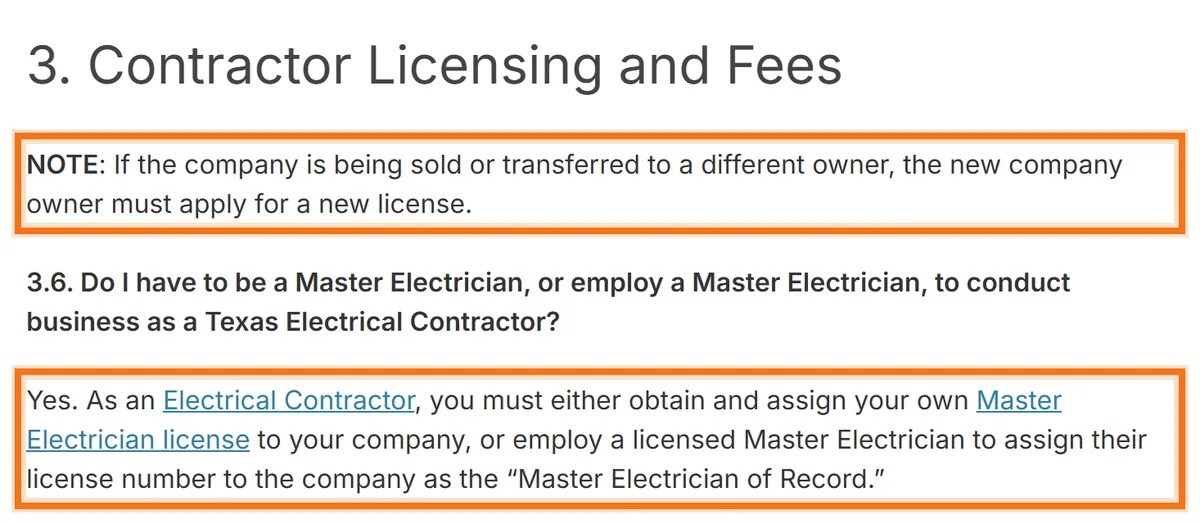
TDLR’s electrical licensing FAQ says it plainly: an electrical contractor must either assign its own Master Electrician license to the company or employ a licensed Master Electrician who assigns theirs as the “Master Electrician of Record.”
The same page notes that if the company is sold or transferred to a different owner, the new owner must apply for a new license, and that when the master electrician of record leaves, the company must notify TDLR and name a replacement within thirty business days. We treat all three as early transaction issues, because the buyer needs a workable plan for the first day after closing.
Start by identifying who can serve after the sale. That may involve evaluating an existing employee or the buyer’s proposed operating team, with the specific arrangement reviewed by your transaction attorney and confirmed with TDLR.
Do not assume a buyer’s existing organization automatically resolves your company’s licensing needs. The buyer, seller, and attorney need to establish the requirements for the proposed transaction before relying on a closing date.
The licensed workforce matters beyond that assigned role. Prepare an internal roster showing each electrician’s license level and tenure. Identify which people supervise work, manage customer expectations, and carry knowledge that has not been documented elsewhere.
Journeymen and master electricians with tenure are scarce and form a large part of what buyers are purchasing. We need to show both who is on the team and how the business supports their continued involvement.
Our firm does not give legal advice. Your attorney handles the legal implications of the transaction and licensing arrangements; TDLR is the official source for licensing requirements.
Will owner dependence or one general contractor lower your price?
Both can reduce value because they make future earnings less certain. A buyer wants to know whether the company can keep winning and completing profitable work after ownership changes.
If every bid passes through you, the buyer is purchasing your judgment as well as the business. An estimator who can price work independently and project managers who run jobs without your daily intervention make the operation more transferable.
We address the owner-dependence discount by making responsibilities visible. Identify who scopes work, checks labor assumptions, approves estimates, resolves field problems, and maintains customer relationships. Then distinguish what others already handle from what still requires you.
A written estimating method helps, but demonstrated performance matters more. Buyers need evidence that someone besides the owner can apply the method and achieve results. If that capability is missing, preparation may be more valuable than immediately taking the company to market.
Customer concentration creates a related problem. If one general contractor or facility provides a large share of revenue, losing that relationship could materially change earnings.
Show revenue and margin by customer, then explain who manages each important relationship. A customer that knows your project managers and works with several people across the company presents a different transition question from one that deals exclusively with you.
We cannot erase concentration by describing the relationship as strong. We can present its history, profitability, current signed work, and dependence on your personal involvement so buyers can evaluate the actual risk.
What does the sale process look like, and how long does it take?
Our published range is three to nine months from engagement to closing. Your readiness, buyer funding, diligence findings, and licensing succession plan affect the timetable. Dalmar Electrical’s 180-day transaction is a completed example, not a deadline for another sale.
Our published ten-step process covers preparation, buyer screening, negotiations, diligence, documents, and closing. For an electrical contractor, we organize the work around the issues that determine whether the company can transfer successfully.
1. Establish your goals and readiness. We discuss timing, operating responsibilities, valuation expectations, and the master electrician succession issue.
2. Prepare the business presentation. We organize the earnings story, revenue mix, team capabilities, customer concentration, and backlog.
3. Approach and qualify buyers. We go first to our own database of buyers, capital groups, and private equity groups, then to public listings. Buyers complete confidentiality and profile requirements, and we test funding ability.
4. Evaluate and negotiate offers. We compare price with the proposed structure, your continuing obligations, and the buyer’s ability to close.
5. Support diligence and documentation. Buyers verify the financial and operating information. Your attorney and CPA address legal documents and tax matters while we coordinate the transaction.
6. Resolve closing requirements. The parties complete the agreed requirements, including the licensing succession plan, before closing.
These are practical workstreams within our ten-step process. They help you see what requires attention without turning the sale into another full-time operating job.
During diligence, consistent answers matter. If the financial statements, job schedules, and customer reports tell different stories, resolve the differences with the appropriate professional. A negotiated offer remains subject to what the buyer can verify.
We also distinguish the headline price from the obligations attached to it. Transition duties and transaction structure vary by deal and are negotiated. Your attorney and CPA should evaluate the legal and tax consequences before you commit.
How MDR & Associates helps
Hire an advisor who can explain your contractor’s earnings, identify suitable buyers, protect confidential information, and negotiate the operating issues that affect closing. Ask who handles negotiations and whether the advisor represents your interests throughout the transaction.
Our sell-side representation puts us on your side of the table. In your sale, we represent you, the seller, and only you. A partner of our firm participates in every negotiation, and our limited engagement load supports direct involvement.
Our fee is 100% performance based: an industry-standard success fee if and when your company sells. If no transaction is completed, you owe us nothing. Discuss the engagement terms with us so you understand how they apply to your proposed sale.
We work alongside your transaction attorney and CPA. They draft legal documents and advise on tax; we manage buyer outreach, negotiations, and the sale process. These roles need to work together without replacing one another.
If the business needs preparation, our pre-exit consulting can focus on the gaps that affect transferability: owner-led estimating, incomplete job costing, customer concentration, or an unresolved master electrician succession plan.
Schedule a confidential conversation or call (855) 637-2776. We can assess whether to approach buyers now or strengthen the business first.
To discuss selling your Dallas-Fort Worth electrical contracting company, call (855) 637-2776. We will start with your goals, your operating strengths, and what needs to be ready for a confidential sale.
Where this fitsFort Worth business brokers and M&A advisors →
Questions owners ask next
Who can help sell an electrical contracting company in Dallas-Fort Worth?
MDR & Associates represents owners of privately held companies with $3 million to $100 million in revenue. We have completed the sale of Dallas electrical contractor Dalmar Electrical to a strategic buyer.
What multiple do electrical contractors sell for?
Our published electrical page says offers most often fall between three and seven times adjusted EBITDA for companies in that revenue range. Repeat service customers support the upper part; the actual offer depends on the business.
Can I sell if I am the master electrician of record?
Yes, but a successor must be in place before closing if you hold that role. TDLR also says a new owner must apply for a new contractor license, so plan both steps early with your transaction attorney.
Do individual electricians buy contracting companies?
Yes. Individual buyers include master electricians and experienced operators, often using SBA financing. We evaluate their ability to fund the acquisition as part of buyer qualification.
How long does selling an electrical company take?
Our published typical range is three to nine months from engagement to closing. Preparation, diligence, financing, and licensing succession can affect the schedule.
What does MDR & Associates charge if the company does not sell?
If no transaction is completed, you owe us nothing. Our compensation is an industry-standard success fee if and when your company sells.