
Deal process
How to compare offers for your Texas business: all-cash, seller financing, earnouts and what you actually keep
Why the highest headline number is often not the best offer, and how to work out what each offer really pays you.

By Michael D. Rubin, CEO & Founder · Updated November 2026 · 1,997 words
The highest headline price is the best offer for your business only about half the time. Between the price in a letter of intent and the money that reaches your account sit debt repayment, a working capital adjustment, escrow, any earnout or seller note, deal costs and tax. Two offers for the same Dallas or Houston company with similar headlines can differ by a quarter or more in what you keep.
This guide shows how to turn every offer into the number that matters: cash at closing, plus what is genuinely likely to follow.
- Compare cash at closing, not headlines. Subtract debt, working capital shortfall, escrow and deferred money first.
- Deferred money is a claim, not proceeds. Value a seller note or earnout at what you would pay for that promise.
- Asset or equity sale changes your tax. Texas has no personal state income tax, but federal tax still applies, and the structure decides how much.
- Certainty is part of the price. A funded buyer at a lower number often beats an unfunded one at a higher number.
Why is enterprise value not what you take home?
The number in a letter of intent is usually enterprise value: the value of the business itself, before its debt and cash are settled. Nearly every transaction is agreed on a cash-free, debt-free basis, meaning you pay off the company's debt at closing and keep the surplus cash.
From there, subtract the working capital adjustment if you are below target, the escrow or holdback, and your transaction costs. What remains is cash at closing. Anything paid later is not proceeds yet. It is a claim on a business you no longer run. If you want to know where the headline number comes from in the first place, our guide to what your business is worth explains how buyers build it.
Offer A or Offer B: what does each really pay?
Here is the same kind of comparison we build with a client when offers arrive. The figures are an illustration, not a market quote, but the shape is one we see again and again:
| Line | Offer A | Offer B |
|---|---|---|
| Headline enterprise value | $10,000,000 | $9,000,000 |
| Debt repaid at closing | −$1,200,000 | −$1,200,000 |
| Working capital adjustment | −$400,000 | $0 (target agreed at actual) |
| Escrow held 18 months | −$1,000,000 (10%) | −$450,000 (5%) |
| Seller note / earnout | −$2,000,000 (earnout, 3 years) | −$500,000 (note, 2 years) |
| Cash at closing | $5,400,000 | $6,850,000 |
How to read this table: start at the headline and work down line by line until you reach cash at closing. The lower offer paid $1.45 million more on the day. Offer A could still pay more in the end, but only if the earnout is achieved in full and the escrow comes back untouched, which is why the deferred lines need their own judgment.
All cash at closing
The simplest offer and, dollar for dollar, the most valuable. There is no collection risk and no dependence on how the business performs once you are gone.
All-cash offers are usually somewhat lower in headline terms, and they should be. A dollar today with no conditions is worth more than a dollar in three years that depends on someone else's management. When a buyer is using bank or SBA financing, an all-cash offer may not be possible at all; our business financing page explains how those structures fit together.
Seller financing: what a seller note really means
With a seller note, you lend part of the purchase price to the buyer and they repay it over time, with interest, usually over two to five years. It is common, it often makes a transaction possible, and it can raise the total you receive.
It also makes you a creditor of a business you no longer control. Before you agree to one, ask four questions: what security backs it, where does the note sit relative to the bank's debt (almost always behind it), what happens if the buyer defaults, and can the buyer offset the note against a warranty claim? That last point is the one sellers most often miss.
As a rule of thumb, discount a seller note by the risk you would apply to any unsecured loan to a business you cannot see inside. If that makes the offer unattractive, it was never as high as it looked.
Earnouts: when part of the price depends on the future
With an earnout, part of the price is paid later, only if the business hits agreed targets. Earnouts exist because buyer and seller disagree about the future, and they settle that disagreement by putting it off.
In our experience a substantial share of earnouts pay less than the seller expected. Usually that is not bad faith; the buyer changes how the business is run, and the target was written against the old way. If you accept one, insist on:
- A revenue or gross profit target, not net profit. Net profit is the easiest number for a new owner to change, entirely legitimately, through overhead allocation.
- Written protections on how the business is run during the earnout: sales staffing, pricing authority, no merging of your accounts into theirs without adjustment.
- Your right to see the numbers, in a set format, on a set schedule, with the right to have them examined.
- A short period. Two years beats five. The further out, the less the business looks like the one you sold.
- A floor, a minimum paid regardless, if you can negotiate one.
Escrow, working capital and the clauses that decide what you keep
Escrow. A portion of the price, commonly 5% to 15%, is held for 12 to 24 months to cover any breach of your representations and warranties. Escrow is normal. What is worth negotiating is the amount, the period, whether it caps your liability, and how a claim is made. A 5% escrow for twelve months is much better than 15% for two years, and buyers rarely present it that way.
Working capital. You are normally required to leave a normal level of working capital in the business. If you are below the agreed target at closing, the price drops dollar for dollar. Agree the definition, the calculation method and the target in the letter of intent; a twelve-month average of the actual balance is common and defensible. Leaving it to the purchase agreement is how a seven-figure surprise appears in the last two weeks, and it is one of the things that most often derails a deal, as our guide to why sales fall apart in due diligence explains.
The clauses below are where the rest of the money is won or lost:
| Clause | What to look for | What it is worth |
|---|---|---|
| Escrow / holdback | Percentage, period, and whether it caps your liability | 5% for 12 months versus 15% for 24 is a large difference in real money |
| Representations and warranties | How wide, how long they survive, and whether a cap and basket apply | An uncapped rep is an open-ended liability after you have spent the proceeds |
| Working capital | Definition, calculation, target, and the true-up mechanism | Routinely a six-figure item; agree it in the letter of intent |
| Non-compete | Geography, duration, and what activity it actually covers | Too wide a clause can block the next thing you wanted to do |
| Transition / employment | How long, on what terms, reporting to whom | Sellers underestimate how different it feels to work for the buyer |
| Earnout protections | Target, control provisions, reporting, floor | Decides whether the deferred money is real |
How to read this table: the middle column is your checklist when a draft agreement arrives, and the right-hand column tells you which items deserve a fight. Escrow, working capital and earnout protections usually move the most money; the non-compete and transition terms decide how the years after the sale feel.
Asset sale or stock sale: the tax difference in what you keep
This is a tax question with a price attached, and it is worth raising before offers arrive rather than after.
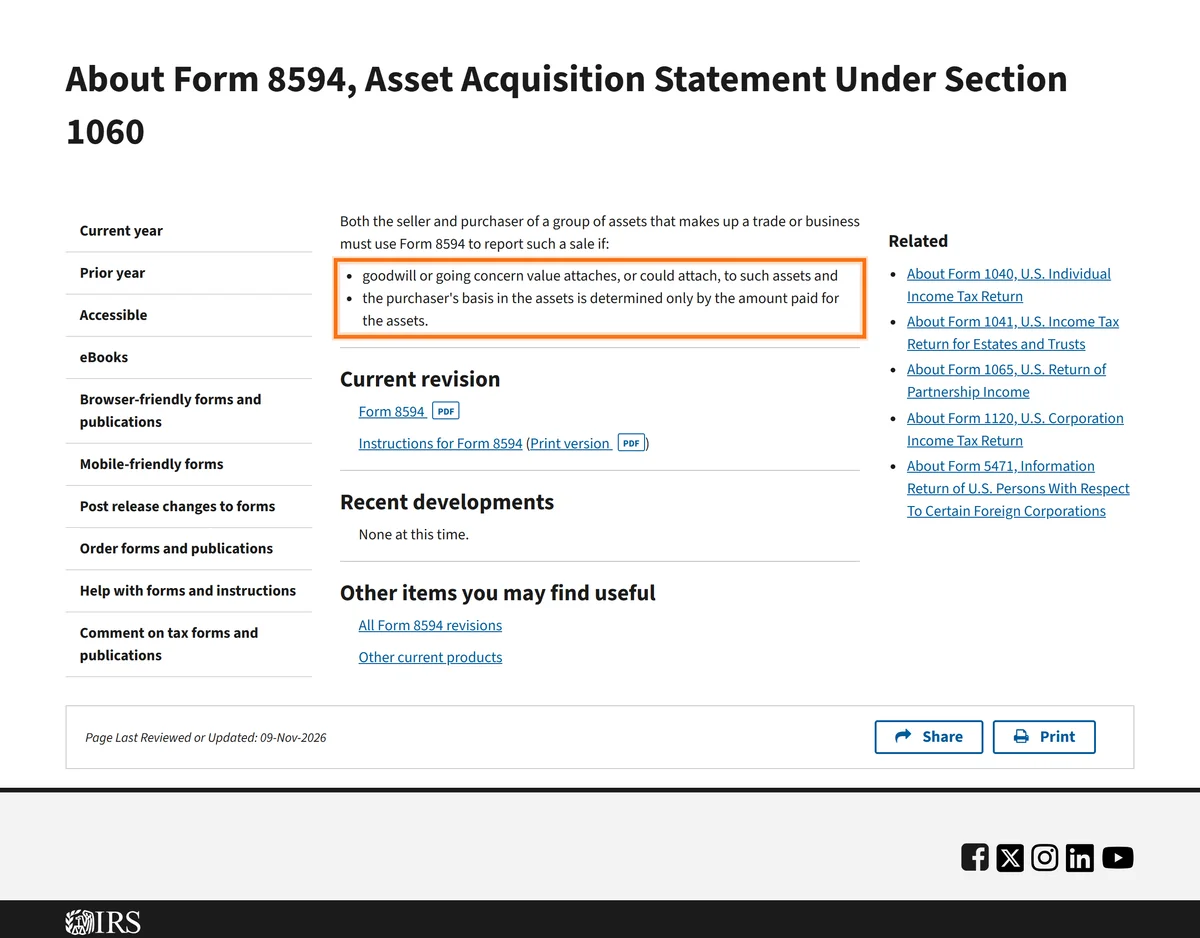
In an asset sale the buyer purchases the assets and takes on selected liabilities. Buyers usually prefer it: they get a stepped-up basis to depreciate and they leave unknown liabilities behind. Sellers usually keep less after tax, because part of the price can be taxed as ordinary income rather than capital gain. Both sides report the allocation of the price on IRS Form 8594, so the allocation is something to negotiate, not an afterthought.
In an equity (stock) sale the buyer purchases the ownership interests and takes the company as it stands, liabilities included. Sellers usually prefer it; buyers price the risk they are inheriting.
For Texas owners there is one piece of good news: Texas has no personal state income tax, so the gain is not taxed again at the state level. Federal tax still applies, and the gap between the two structures after tax is frequently 5% to 15% of the proceeds. Model both with your CPA before you negotiate; our guide to calculating after-tax proceeds walks through the steps.
Certainty and the things that are not money
A funded strategic acquirer at $9 million and an unfunded individual at $10.5 million are not two offers of the same kind. The second carries a real chance of using up six months and your exclusivity, then sending you back to market with a story attached. Weigh three things before the headline: how the purchase is funded and whether that funding is committed, what the buyer has closed before, and how many conditions still stand between the letter of intent and closing.
Then ask every buyer one question: "Walk me through the last transaction you closed. What changed between the letter of intent and closing, and why?" A buyer who explains a genuine adjustment, and what caused it, is one you can work with. Then call a seller they bought from and ask two things: did the price move after the letter of intent, and would you do it again?
Finally, the parts that are not money. Owners rarely rank them highly at the start and often rank them highest afterwards: what happens to the employees, whether the name survives, how long you are expected to stay, and how wide a non-compete you are signing.

A comparison worth doing on paper
- Convert every offer to cash at closing, after debt, working capital, escrow and costs
- Value deferred money at what you would actually pay for that promise, not at face value
- Model the federal tax on each structure with your CPA: asset and equity sales differ substantially
- Score each buyer's certainty of closing: funding, experience, references from previous sellers
- Then, and only then, look at the headline
This only works if you have more than one offer to compare. That is why our process is built to bring several letters of intent at the same time rather than one after another. Competition is what makes the comparison worth having. If you have a single offer in hand already, our guide to evaluating an unsolicited offer covers what to do next.
How MDR & Associates helps you compare offers
MDR & Associates has represented owners of companies with $3 million to $100 million in revenue since 2008, from our corporate office at 1518 Legacy Dr., Suite 220, in Frisco, for owners in Dallas, Fort Worth, Frisco, Austin, Houston and San Antonio. Buyers sign an NDA and are qualified before they learn your company's name, every company goes to market with a professionally produced HD marketing video, and we negotiate several letters of intent at the same time. Then we sit down with you and put every offer through the comparison above before any is accepted. You can see 77 of the companies we have sold, by name, on our results page.
Our fee is a success fee, paid only if and when your company sells. To find out what your company could bring, request a free snapshot valuation or call (855) 637-2776. It is confidential, and nobody is contacted without your permission.
Questions owners ask next
Is the highest offer always the best one?
No. Once debt, working capital, escrow and deferred payments are taken out, a lower headline offer often pays more at closing. Compare cash at closing first.
How much of the price is usually held in escrow?
Commonly 5% to 15% of the price, held for 12 to 24 months. The amount, the period and whether it caps your liability are all negotiable.
Should I accept an earnout?
Only with protections: a revenue or gross profit target, rules on how the business is run, the right to see the numbers, a short period and ideally a floor. Value it below face.
Do I pay state income tax on the sale of my Texas business?
Texas has no personal state income tax, so the gain is not taxed by the state. Federal tax still applies, and whether the deal is an asset or stock sale changes how much.
What is a working capital target?
The level of working capital you agree to leave in the business at closing. If you are below it, the price drops dollar for dollar, so agree the target in the letter of intent.
When should I bring in my CPA?
Before offers arrive. Your CPA should model the after-tax result of an asset sale and a stock sale so you know what each structure is worth to you when you negotiate.