
Confidentiality
How to sell your business confidentially in Texas, without employees or customers finding out
Blind profiles, buyer screening, NDAs, controlled release and the question of when to tell your team, from advisors who run confidential sales across Texas.

By Michael D. Rubin, CEO & Founder · Updated November 2026 · 1,708 words
Also answersHow can I confidentially sell a business without alarming employees or customers?
A business sale stays confidential because information is released in stages, to buyers who have been screened and are under a signed agreement, not because everyone involved promises to be discreet. Done properly, your employees, customers, suppliers and competitors in Dallas, Houston or anywhere in Texas learn about the sale when you decide to tell them, which is usually after it has closed.
This is the most common worry owners bring to a first meeting, and it is a reasonable one. A leak costs real money: key employees leave, customers start looking, competitors call your accounts. Here is how the process is built to prevent it, and how to sell confidentially without alarming employees or customers.
- Stage one: the company goes to market as a blind profile that does not identify it.
- Stage two: every buyer signs a confidentiality agreement and proves they can fund the purchase before learning your name.
- Stage three: detail is released in layers; customer names and contracts wait until a letter of intent.
- Employees are usually told at or just after closing, together with the new owner.
- Confidential is not the same as one buyer: a quiet process still reaches many qualified buyers.
Stage one: the blind profile
Your company goes to market as a blind profile, an anonymous summary describing the business without identifying it. It gives a buyer enough to know whether they are interested and nothing they could use to work out who you are.
A blind profile typically says: industry and sub-sector, general region ("North Texas" rather than a city), revenue and adjusted earnings ranges, years established, employee count as a band, and a short description of the customer base. It never contains the company name, the exact address, customer names, the website, photographs of premises or vehicles, or a number so specific it identifies you in a small market.
In a narrow industry, even a range can identify a company. If yours is one of three of its kind in Texas, we widen everything and market to a shortlist rather than publicly.
What a blind profile looks like in practice
It helps to see one. This is the shape of a blind profile for a company we would take to market: enough for a buyer to know whether to sign, nothing that identifies the seller.
| Field | What it says | What it never says |
|---|---|---|
| Business | Commercial mechanical contractor, service and project work | The trading name |
| Location | North Texas | The city, the address, the yard |
| Revenue | $8M–$12M | The exact figure |
| Adjusted EBITDA | $1.5M–$2M | The exact figure |
| Established | Over 20 years | The founding year |
| Employees | 40–60 | The exact count |
| Customers | Commercial property managers and general contractors | Any customer name |
| Reason for sale | Owner retirement | Anything about the owner personally |
How to read this table: the middle column is what every interested buyer sees; the right column is what nobody sees until they have signed and qualified. Read your own draft profile the way a competitor in your city would. If you can guess who it is, the ranges are too narrow.
Stage two: screening the buyer
Before a buyer sees anything beyond the blind profile, they complete two things.
- A confidentiality agreement. They agree not to disclose the business's identity, its financials or the fact that it is for sale; not to contact your employees, customers or suppliers directly; not to use the information for any purpose other than evaluating the acquisition; and to return or destroy the materials if they do not proceed.
- A buyer profile. Who they are, what they have bought before, and, the part that matters, evidence they can fund the purchase: proof of funds, a lender letter, or a fund's investment criteria.
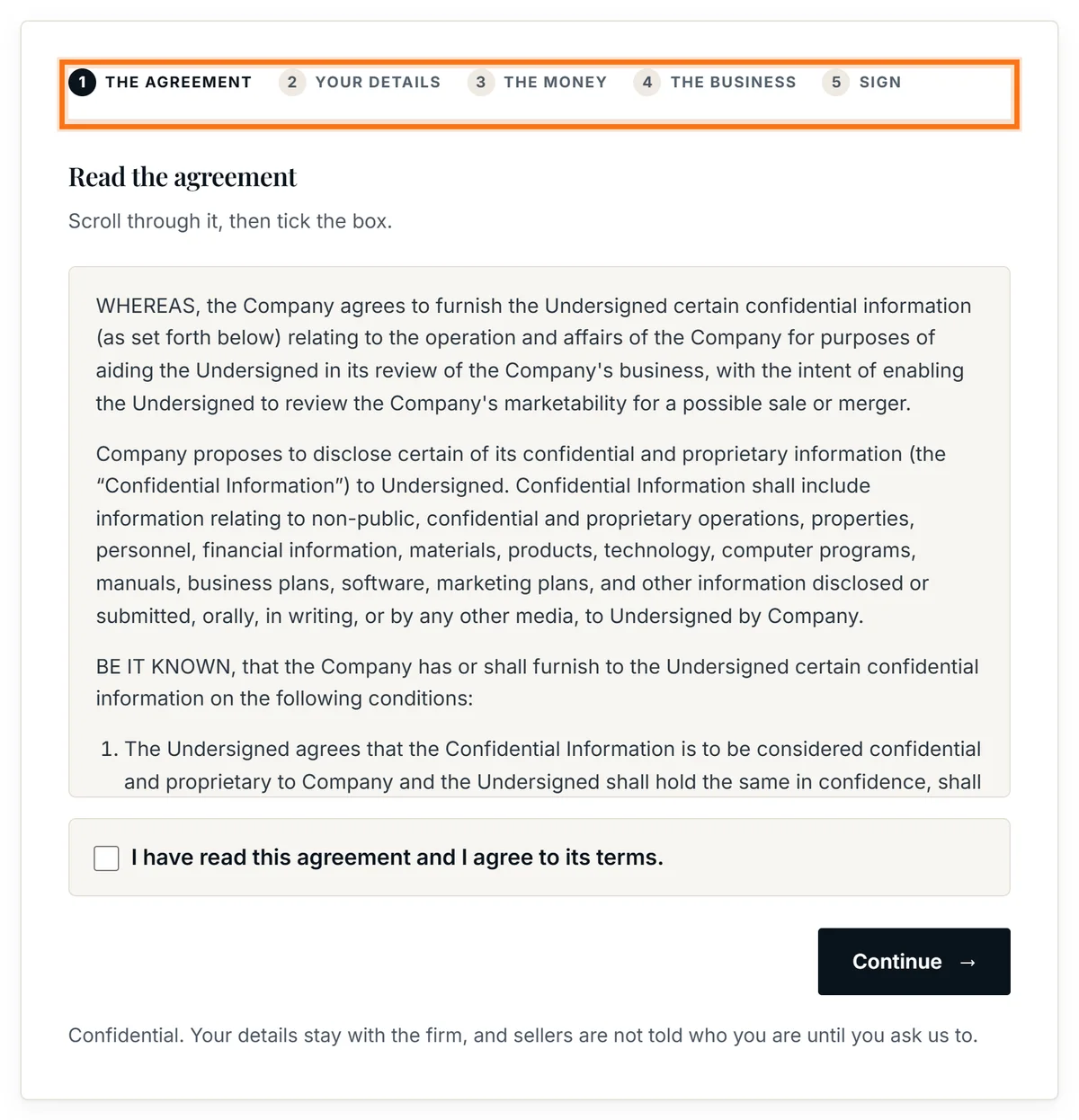
The second document does most of the work. Most leaks come not from bad actors but from unqualified, curious parties who were never going to buy. A buyer who has proved they can write the check has a reason to protect the process; a tire-kicker has none. You can see both documents from the buyer's side: our buyer NDA and buyer profile.
Stage three: controlled release
Even after an NDA, information goes out in layers. The confidential business profile comes first: the full picture, but with customers described by industry and size rather than named. Detailed financials follow. Customer names, key contracts and employee details typically wait until a letter of intent is signed and due diligence begins.
Documents live in a controlled data room, not in email attachments. Site visits are scheduled outside business hours or presented as something else entirely. In many transactions we have run, the buyer walked the premises on a Sunday.
Where leaks actually come from
Leaks follow a pattern. Each source below has a simple fix, and most of them are decisions you make before the company goes to market:
| Source | How it happens | What prevents it |
|---|---|---|
| The owner | Mentioning it to a trusted employee, a supplier or at an industry event | Decide who knows before you start, write the list down, and stick to it |
| Advisors and staff | A document left visible, a call taken in an open office, an email to the wrong address | A separate email address for the transaction; documents in a controlled data room, not attachments |
| Unqualified buyers | Someone who was never going to buy, telling a competitor | Financial qualification before information, not after |
| Public listings | A blind profile detailed enough to identify you in a small market | Widen the ranges, or do not list publicly at all |
| The buyer's team | Their staff, lender or advisors talking | An NDA that binds their representatives too, and staged disclosure |
What this means for you: the first row is the one you control completely, and it is the most common. The other four are the advisor's job, so ask any firm you interview how it handles each one before you sign an engagement letter.
Confidentiality inside your own company
The hardest leak to prevent is the one that starts at home. Some practical rules that cost nothing:
- Use a separate email address for everything to do with the transaction, and never the company system for documents.
- Take calls somewhere private. An owner who suddenly closes the office door for an hour every Tuesday is telling the team something.
- Do not change your habits visibly. Postponing the new hire, canceling the equipment order or stopping capital spending all read as a signal, and they lower the value the buyer is looking at.
- Keep the advisor's name off the calendar. Calendar entries are read by more people than owners think.
- Brief the one person who has to know, usually a CFO or a bookkeeper, properly and under their own confidentiality agreement, rather than letting them work it out.
When should you tell your employees?
The honest answer: later than most owners want to, and earlier than the buyer usually asks. In the great majority of transactions, employees are told after closing, or immediately before, in a joint announcement with the new owner.
The reason is not secrecy for its own sake. A sale can fail at any point until the funds are wired, and an announcement you cannot take back does damage that no amount of explaining repairs. Employees who know a sale was attempted and abandoned start looking, whatever you tell them.
There are exceptions. A key manager whose cooperation the transaction depends on may need to be brought in earlier, usually under their own confidentiality agreement and often with a stay bonus. That is a judgment made case by case, and it is worth talking through in a first conversation.
What happens if it does leak
It occasionally does. What matters then is speed and a straight answer.
If a customer or supplier asks, the honest and usually accurate reply is that the company regularly receives approaches and evaluates its options, and that nothing has changed for them. Denial that later proves untrue costs far more than the question did.
If an employee asks directly, do not lie. "We look at options from time to time, and if anything ever changes you will hear it from me first, not from a rumor" is both true and reassuring. And tell your advisor immediately. A leak handled in a day is a rumor. A leak handled in a month is a fact.
What confidentiality does not mean
It does not mean marketing quietly to one buyer. That is the most common, and most expensive, misunderstanding we encounter.
A single buyer with no competition sets the price themselves. A confidential process still reaches many buyers; it simply controls what each one knows and when. Confidentiality and competition are not in tension. Running one buyer is not confidentiality; it is a negotiation you have already lost.
Our process takes a company to a screened buyer database, capital groups and private equity groups first, and only then places a general blind advertisement if that has not produced an acceptable offer. The full ten steps are here. Two things also outlive the sale: agree the public announcement with the buyer before closing, and read the purchase agreement's confidentiality, non-compete and non-solicit terms before you sign, because their geography and length are negotiable.
Why MDR & Associates for a confidential sale
Integrity, transparency and confidentiality are written into the firm's own values. We have been selling privately held companies with $3 million to $100 million in revenue since 2008, from offices serving Dallas, Fort Worth, Frisco, Austin, Houston and San Antonio, and 77 of the companies we have sold are listed by name on our results page.
Every buyer signs our NDA and shows they can fund the purchase before learning your name. Your company goes to market with a confidential profile and a professionally produced film, reviewed by you before anything goes out, and we negotiate several letters of intent at the same time so confidentiality never costs you competition. Our fee is a success fee, paid only if the company sells; see our fees page and how we sell your business.
If confidentiality is what has stopped you from finding out what your company is worth, start with the step that involves no market exposure at all: a free snapshot valuation. Nothing leaves our office and nobody is contacted. Or call (855) 637-2776.
Questions owners ask next
Can I sell my business without my employees knowing?
Yes. In most sales employees are told at or just after closing, in a joint announcement with the new owner. Only people the deal truly depends on are told earlier, under their own confidentiality agreement.
Does a confidential sale mean fewer buyers?
No. A confidential process still reaches many qualified buyers; it controls what each one learns and when. Marketing to a single buyer usually costs price, not secrecy.
When does a buyer learn my company's name?
Only after signing a confidentiality agreement and showing they can fund the purchase. Customer names and key contracts usually wait until a letter of intent is signed.
Should I list my business on public for-sale websites?
Only as a blind listing, and only if direct outreach to screened buyers has not produced an acceptable offer. In a narrow industry, even a blind listing can identify you, so we market to a shortlist instead.
What should I tell a customer who asks if the company is for sale?
That the company receives approaches from time to time, evaluates its options, and nothing has changed for them. Never deny something that may later prove true, and tell your advisor the same day.
Do confidentiality obligations continue after closing?
Usually. Purchase agreements often limit what you may disclose about the terms and add a non-compete and non-solicit. Their scope and length are negotiable, so read them before you sign.