
Texas-wide · Industries
Who can help me sell a pharmaceutical distribution business in Texas?
Who you need beside you to sell a Texas pharmaceutical or medical product distributor, what the official license and registration rules say about a change of owner, and what a buyer checks before closing.

By Michael D. Rubin, CEO & Founder · November 2026 · 2,272 words
Selling a pharmaceutical distribution business in Texas takes three advisers working together: an M&A advisor who finds qualified buyers and negotiates the deal, a regulatory attorney who handles the state licenses and federal registrations, and a CPA who handles the numbers and the tax. The licenses matter most, because Texas says a wholesale drug distribution license cannot be transferred to a new owner.
Below is who does what, what the official rules from Texas DSHS, the DEA and the FDA say about a change of owner, what a buyer checks in diligence, and how those steps fit into the timetable of a sale.
- Licenses do not travel with the sale. Texas DSHS says the new owner must obtain a new license, as licenses are non-transferable.
- A DEA registration needs written consent to transfer, and the DEA rule asks for notice at least 14 days before the proposed transfer.
- The regulatory attorney is not optional. Licensing questions shape the deal structure, so that lawyer should be in place before buyers see anything.
- Buyers check the paper behind the product: licenses, supplier authorizations, customer contracts, inventory records and inspection history.
- Licensing steps add time. Build them into the plan from the start instead of discovering them after a letter of intent.
Who does what when you sell a pharmaceutical distribution business?
Owners looking for advisers to sell a pharmaceutical distribution business often expect one firm to cover everything. No single adviser should. The sale has a market side, a regulatory side and a financial side, and each needs someone who does that work every day.
The table shows the usual division of work and when each person should start. The regulatory attorney starts earlier than most owners expect.
| Adviser | What they handle | When they start |
|---|---|---|
| M&A advisor | Opinion of value, confidential marketing package, buyer screening, several letters of intent at once, negotiation, keeping the timetable | First meeting, through closing |
| Regulatory attorney | Which licenses and registrations you hold, what a change of owner requires for each, the filings and their timing | Before buyers see anything |
| Transaction attorney | The letter of intent terms, the purchase agreement, asset sale or stock sale | From the letter of intent; often the same firm as the regulatory attorney |
| CPA | Financial statements, support for adjusted earnings, the tax effect of the structure | Before going to market, and again at closing |
| Your compliance lead or designated representative | License files, inspection history, controlled substance records, answers to the buyer's questions | Due diligence; the buyer may also want this person to stay |
How to read this table: the first two rows must start before any buyer hears about the company. If the regulatory answers arrive late, they arrive in the middle of a negotiation, where every surprise costs time or price. We do not give legal or tax advice; your attorney and CPA own those answers, and we keep them moving together.
What does Texas say happens to your distributor license when you sell?
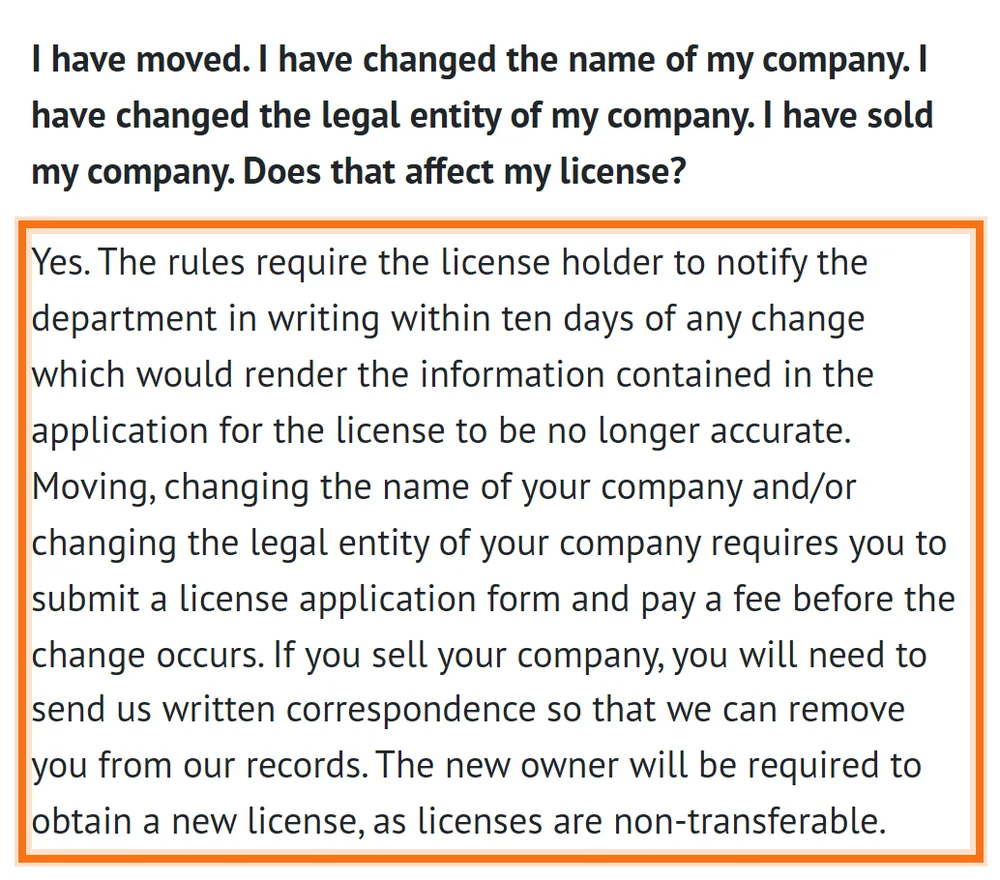
The Texas Department of State Health Services licenses drug manufacturers and distributors. Its licensing FAQ answers the seller's question directly: "If you sell your company, you will need to send us written correspondence so that we can remove you from our records. The new owner will be required to obtain a new license, as licenses are non-transferable."
The same answer says the license holder must notify the department "in writing within ten days" of any change that makes the license application no longer accurate. Moving, renaming the company or changing its legal entity "requires you to submit a license application form and pay a fee before the change occurs." So a restructuring done to prepare for a sale can be a licensing event on its own.
The Texas Health and Safety Code, Chapter 431 adds two points a buyer will check. A wholesale distributor of prescription drugs needs a license "for each place of business," and a license "expires on the second anniversary of the date of issuance." Every warehouse counts, and every expiry date goes on the diligence list.
Why does the designated representative matter to a buyer?
Chapter 431 asks each place of business to name a designated representative, and it sets qualifications for that person. Among them, the designated representative must "be at least 21 years of age," must have been "employed full-time for at least three years by a pharmacy or a wholesale distributor" in a related role, and must "be employed by the applicant full-time in a managerial-level position."
Read that from the buyer's side. A buyer applying for its own Texas license needs a qualified person at each location. If that person is you, or one long-serving manager, the buyer will ask early whether that person stays after closing.
Three things to settle before going to market:
- Who your designated representative is today at each licensed location, and whether anyone else in the company meets the statute's qualifications.
- Whether that person knows about the sale, and when they should. A key employee told too early is a confidentiality risk; told too late, a retention risk.
- What the buyer will need from you after closing. Our guide to the documents to organize before selling covers the general files; the license file and the designated representative's records sit on top of those.
What do the DEA and FDA rules add to a Texas distributor sale?
If the company handles controlled substances, it holds a DEA registration, and the federal rule on transfers is 21 CFR 1301.52. It says no registration "shall be assigned or otherwise transferred except upon such conditions as the Administration may specifically designate and then only pursuant to written consent."
The FDA side concerns who may trade prescription drugs at all. The FDA's page on annual licensure reporting says wholesale drug distributors "must be appropriately licensed and report licensure and other information to FDA annually to be authorized trading partners under the Drug Supply Chain Security Act." Your suppliers and customers check that status, so a buyer will too.
The table puts the rules side by side, with what each means for your sale.
| Rule | What the official text says | What it means for your sale |
|---|---|---|
| Texas DSHS licensing FAQ | The new owner "will be required to obtain a new license, as licenses are non-transferable" | The buyer applies for its own Texas license; it goes into the timetable |
| DSHS prescription distributor application (EF23-13004) | If only the actual owners change, "please call our office prior to submitting this application"; "Please allow 4-6 weeks for processing" | Your attorney calls DSHS before filing, and the plan leaves weeks for the license |
| Texas Health and Safety Code 431.402 | A license is needed "for each place of business" | Every location is checked separately |
| 21 CFR 1301.52(b) | A DEA registration transfers only "pursuant to written consent" | DEA consent is a closing condition to plan for |
| 21 CFR 1301.52(d) | Notice to the DEA "at least 14 days in advance of the date of the proposed transfer" | The closing date must allow for the notice period |
| 21 CFR 1301.52(e) | "a complete inventory of all controlled substances being transferred" on the date of transfer | Closing day includes a counted inventory, and the records move to the buyer |
| FDA, DSCSA licensure reporting | Distributors must be licensed and report to FDA annually "to be authorized trading partners" | The buyer checks your reporting history and plans its own |
How to read this table: the middle column is the official wording, shortened. Read the right-hand column as your planning list. None of it decides the deal by itself, but each row is a date, a filing or a consent that has to fit between the letter of intent and closing. Your regulatory attorney confirms how each rule applies to your company, your products and the structure you choose.
Asset sale or stock sale: which questions go to your attorney?
Owners often hear that one structure avoids the licensing work. Do not assume it. The DSHS form treats a change of the actual owners, with the same name, EIN, DBA and location, as a case for a phone call to the department first, and the DEA rule speaks of transferring a registration with written consent. How those apply to your deal is a legal question.
Take these questions to the regulatory attorney before the company goes to market, and ask for the answers in writing:
- For each license and registration: what does an asset sale require, and what does a stock sale require?
- Timing: which filings happen before closing, which after, and how long each regulator has said it takes?
- Operating gap: can the buyer operate from the closing date, or does the deal need a transition arrangement until its own license is issued?
- Other states: the Texas application asks for "a list of all licenses and permits issued to the applicant by any other state," so what does each of yours require?
- Other products: if you also distribute medical devices or nonprescription products, which other licenses apply?
The answers often decide which buyers fit. A buyer that already holds the licenses it needs faces a different path from a first-time buyer. That is useful to know before choosing whom to approach.
What does a buyer check in diligence?
A buyer of any distributor looks hard at working capital, inventory, supplier agreements and customer concentration, as our distribution and wholesale page explains. A pharmaceutical or medical product distributor gets those checks plus a compliance review. Have these ready before the first buyer meeting:
- License and registration file: every state license, DEA registration and permit, with holder, location, number and expiry date.
- Manufacturer and supplier agreements: whether you are an authorized distributor, whether the agreement can be assigned, and what a change of control triggers. Our guide on selling a distributor with exclusive supplier agreements covers the consent question.
- Customer contracts: pharmacies, clinics, hospitals or other buyers, their terms and any change-of-control clause.
- Inventory records: stock by item, lot and expiry date, returns and write-offs, and controlled substance records. Our guide to preparing inventory and working capital records shows how to build them.
- Inspection and compliance history: inspection reports, corrective actions, written procedures and the records those procedures produce.
- FDA trading partner status: proof that licensure reporting is current.
A gap in this file is not the end of a sale. Found by you before marketing, it is a task. Found by the buyer during diligence, it is a reason to reopen the price or the timetable.
How do licensing steps fit into the timeline of a Texas sale?
In our experience, a sale takes three to nine months on average from engagement to completed transaction. A regulated distributor adds steps that run on the regulators' timetable, not ours, so the order matters:
- Before marketing: the regulatory attorney maps every license and registration and what a change of owner requires. The CPA prepares the financials.
- During marketing: buyers learn early that licensing is mapped, which supports the price and filters out buyers who cannot qualify.
- At the letter of intent: the closing conditions name the consents and licenses, and the timetable allows for them.
- Between signing and closing: the buyer applies for its own licenses, the DEA notice goes in, and the closing-day inventory is planned.
If you want a sense of value before deciding anything, a free snapshot valuation is confidential and commits you to nothing.
Who buys a pharmaceutical distributor, and how do you test an adviser?
Our distribution page names three kinds of buyer for the sector: national and regional distributors, private equity, and manufacturers integrating forward. Each reacts differently to the licensing work, so the buyer list and the licensing map should be built together.
Then ask any adviser, including us, these questions:
- Which distribution companies have you sold, by name, and which regulated businesses?
- How do you keep the sale confidential from suppliers, customers and employees while the licensing questions are worked out?
- How do you screen buyers before they learn the company's name?
- How will you work with my regulatory attorney, and who keeps the timetable?
Our straight answer to the first question: the distribution and wholesale companies we publish include U-Fix-It Appliance Parts (August 2024), Tri-Tex Sales (December 2019) and Elastic By The Yard (April 2015). Our industries page says we have also sold pharmacies. We have not published the sale of a pharmaceutical distributor, and we would rather tell you that than imply it. Our article on advisors who sell distribution businesses covers the wider sector.
How MDR & Associates helps sell a Texas pharmaceutical distribution business
MDR & Associates is a sell-side M&A advisory firm for privately held companies with $3 million to $100 million in revenue. We run the market side of the sale and work alongside your regulatory attorney and CPA, who own the licensing, legal and tax answers. We have closed more than 250 transactions since 2008, and 77 companies are listed by name on our results page.
Our ten-step process is built for confidentiality. Buyers sign a confidentiality agreement and complete a financial profile before they learn your company's name. We go first to our own database of qualified individual buyers, capital groups and private equity groups, and we negotiate several letters of intent at the same time.
Our fee is 100% performance based: a success fee if and when the company sells, and nothing if no transaction closes. The fees page lists what the fee covers and what you pay separately, such as your attorney and CPA.
The first step is a complimentary discovery meeting and opinion of value based on your last three years of financials. Request a free snapshot valuation or call (855) 637-2776.
Where this fitsSelling a distribution company in Texas →
Questions owners ask next
Does the buyer keep my Texas wholesale drug distributor license?
Texas DSHS says no: if you sell your company, the new owner must obtain a new license, because licenses are non-transferable. Your regulatory attorney confirms how that applies to your structure and when the buyer should apply.
Should I tell my suppliers before I sign a letter of intent?
Read the agreements first. Some need the supplier's consent to a change of control and some do not. Your attorney tells you what each requires, and we plan with you when and how any supplier is approached, so the sale stays confidential until it has to be shared.
Will the buyer want my designated representative to stay?
Often, yes. Texas law requires a qualified designated representative at each licensed place of business, and the buyer needs one for its own license. If that person is you or one key manager, expect the question early and plan the answer before going to market.
Do I need a formal valuation before selling a distributor?
No. The first step with us is a complimentary discovery meeting and an opinion of value based on your last three years of financials. A formal third-party valuation by an accredited appraiser is optional and paid for separately.
Can you sell a distributor that handles controlled substances?
The sale process is the same ten steps. What changes is the regulatory work: DEA consent, the advance notice and the closing-day inventory. Your regulatory attorney handles those filings, and we build the timetable and closing conditions around them.
What does it cost to use MDR & Associates?
Our fee is 100% performance based: a success fee if and when the company sells, and nothing if no transaction closes. The percentage depends on the size of the transaction and is set in the engagement letter. Your attorney and CPA are paid separately.
Sources and further reading
- Texas DSHS: Frequently asked questions about licensing, drug manufacturers and distributors
- Texas DSHS: In-state wholesale distributors of prescription drugs, license application (EF23-13004)
- Texas Health and Safety Code, Chapter 431 (Subchapter N, wholesale distributors of prescription drugs)
- eCFR: 21 CFR 1301.52, termination and transfer of DEA registration
- FDA: Annual licensure reporting by wholesale drug distributors and third-party logistics providers