
Dallas–Fort Worth · Valuation
Who can value my Frisco business for a sale rather than for taxes or a divorce?
Why a valuation for a sale is different work from one for estate or gift tax or a divorce, who prepares each, and how a Frisco owner orders the one a sale needs.

By Michael D. Rubin, CEO & Founder · November 2026 · 2,093 words
To value a Frisco business for a sale, you need someone who measures what real buyers would pay today: an M&A advisor's opinion of value, backed when needed by a formal valuation written for a sale. A tax appraisal answers a legal definition on a set date, and a divorce valuation answers a court's questions. MDR & Associates does the sale kind from our Texas Corporate Office in Frisco.
Below is why the purpose changes the work, who prepares each kind of valuation, why a tax or divorce figure is not a price, and how to order the right one.
- Purpose comes first. The same company can carry different, correct values for a sale, an estate or gift tax return and a divorce.
- A sale valuation looks at the market. It asks which buyers exist, what they pay for and what they discount.
- Tax and divorce valuations answer legal questions set by the tax regulations or the Texas Family Code, with your CPA or attorney steering them.
- A tax or divorce number is not an asking price. Use it as information, not as the figure you take to buyers.
- Start free. A complimentary opinion of value tells you where a sale stands before you pay for a formal report.
Why does the purpose of a valuation change the work?
A valuation answers a question, and the question depends on who will rely on the answer. A buyer, the IRS and a family court ask different questions, so the appraiser uses a different date, a different definition of value and sometimes values a different thing: the whole company, or one owner's share of it.
The table compares five common purposes and what each one is really asking.
| Purpose | The question it answers | Who usually prepares it | Who steers it |
|---|---|---|---|
| Sale of the company | What would qualified buyers pay, on what terms, in the current market? | An M&A advisor's opinion of value; a formal valuation if a buyer, lender or partner needs one | You and your M&A advisor |
| Estate tax | What was the interest worth under the tax definition of fair market value at the valuation date? | An accredited appraiser | Your estate attorney and CPA |
| Gift tax | What was the interest given worth on the date of the gift? | An accredited appraiser | Your estate attorney and CPA |
| Divorce | What is the business, or the interest in it, worth for dividing the marital estate? | An accredited appraiser, sometimes one for each side | The family-law attorneys and the court |
| Partner buyout | What price per share will both sides accept? | An accredited appraiser, often under a formula in your agreements | The partners and their attorneys |
How to read this table: look at the last column. In a sale, you choose the question. For tax and divorce, someone else frames it, and the valuation is written to satisfy them. That is why a report built for one row rarely serves another without changes.
What does the tax code mean by fair market value?
Estate and gift tax valuations follow a definition in the federal regulations. For an interest in a business, 26 CFR 20.2031-3 describes fair market value as "the net amount which a willing purchaser whether an individual or a corporation, would pay for the interest to a willing seller, neither being under any compulsion to buy or to sell and both having reasonable knowledge of relevant facts."
The same section lists the factors, including "a fair appraisal as of the applicable valuation date of all the assets of the business, tangible and intangible, including good will" and "the demonstrated earning capacity of the business." For gifts, 26 CFR 25.2512-1 says the value "at the date of the gift shall be considered the amount of the gift."
Notice the words. The buyer and seller are hypothetical, and the date is fixed by a death or a gift. A sale is the opposite: real buyers, with their own reasons to pay more or less, on a date you choose. Your CPA and estate attorney decide what a tax filing needs. We do not give tax advice.
What does a Texas divorce valuation have to answer?
A divorce valuation exists to help divide property, and Texas law frames that division. The Texas Family Code, Chapter 3 says: "Community property consists of the property, other than separate property, acquired by either spouse during marriage." Section 3.003 adds that property possessed by either spouse during or on dissolution of marriage "is presumed to be community property."
Chapter 7 sets the rule for the division: the court "shall order a division of the estate of the parties in a manner that the court deems just and right, having due regard for the rights of each party and any children of the marriage."
So a divorce appraisal may have to answer questions a buyer never asks: what part of the company is separate property, what changed during the marriage, and what date counts. Those are legal questions for your family-law attorney, not for an M&A advisor. If a divorce and a sale overlap, tell both your attorney and your advisor at the start.
Why is a tax or divorce figure not a sale price?
A common question is whether the number from an estate plan or a divorce is what the company would sell for. It might land close, but it was never built to answer that question. Four reasons it can differ from a price:
- Hypothetical buyer versus real buyers. A tax valuation imagines one informed buyer. A sale finds actual ones, and a strategic buyer that gains customers or capacity can value the company differently from anyone else.
- The date. A tax or divorce figure is fixed to a past date. Buyers price the company as it stands when they make an offer, with this year's results.
- What is valued. A gift of a minority share, or one spouse's interest, is not the same thing as 100% of the company offered to a buyer. Ask your appraiser how the interest valued affects the conclusion.
- Terms. A price comes with terms: cash at closing, a seller note, an earnout, the working capital left behind. A valuation report states a value; a buyer states a deal.
Buyers also price things an appraisal may only describe: customer concentration, owner dependence, records that do not reconcile, leases and contracts that do not transfer. Our business valuation page lists the factors that raise and lower value. Our article on what your business is worth explains how buyers build their number.
Who prepares each kind of valuation?
Three kinds of people value private companies, and they are not interchangeable:
- An accredited appraiser writes a formal valuation report with a concluded value for a stated date. This is what a tax return, a court, a lender or a partner usually relies on.
- A CPA prepares the financial statements and tax returns every valuation starts from. Some CPA firms also have valuation practices. Your CPA is the right person to say what a tax filing requires.
- An M&A advisor gives an opinion of value from the market side: what buyers pay for, what they discount and what range a sale could reach.
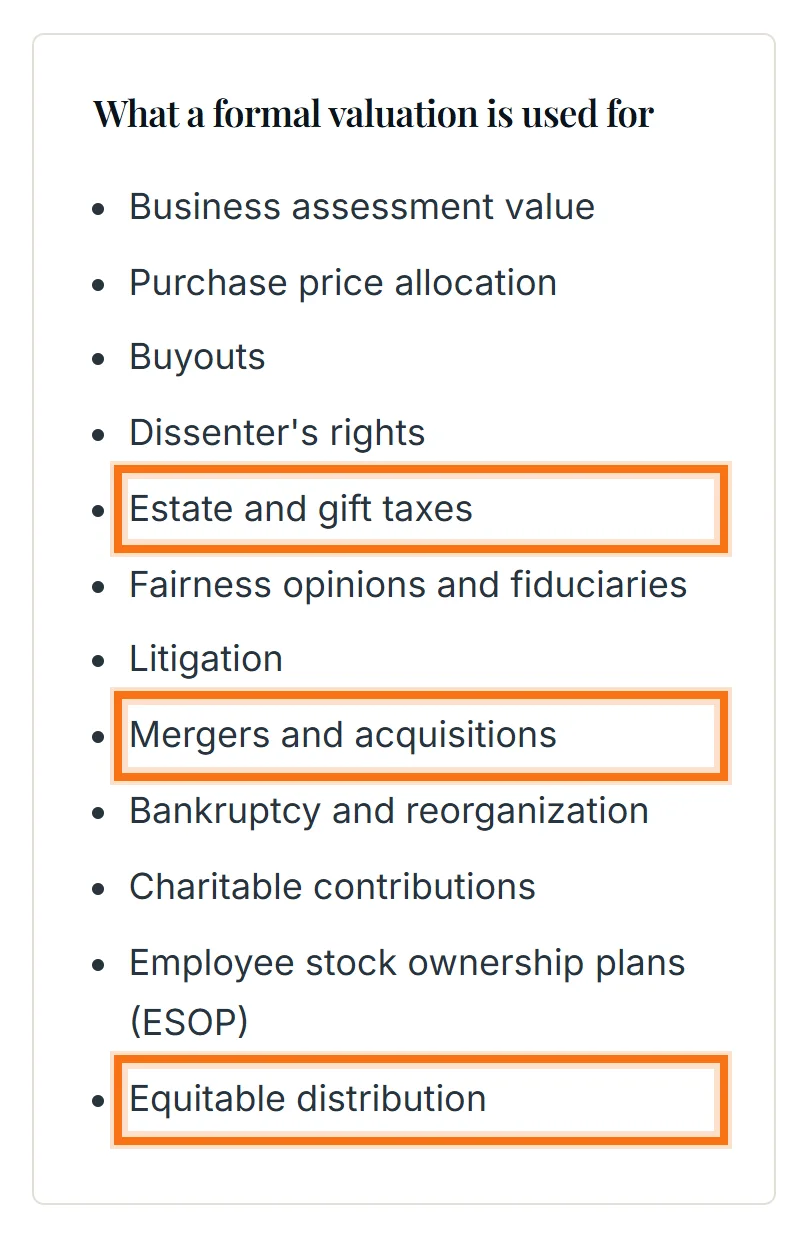
As our valuation page shows, a formal valuation serves many purposes, from estate and gift taxes to mergers and acquisitions and equitable distribution. The appraiser has to know which one applies, because it shapes the report. Our guide to a credible business appraisal lists the credentials to check, and our guide to a formal third-party valuation before a sale explains when the formal report is worth paying for.
What do you get from a valuation for a sale?
A sale valuation should leave you with more than a number. It should tell you what buyers will pay for, what they will discount, and what you could change before going to market. Here is what each level of a sale valuation gives you with us:
- From the free snapshot: a value range and what drives it, from an advisor who reads the four facts you send. It takes a day and answers one question: is a closer look worth your time?
- From the discovery meeting: an opinion of value from low to high, based on your last three years of financials, and a conversation about your options: sell now, prepare first, or sell part and keep part.
- From a formal third-party valuation: a written report by an accredited appraiser with a concluded value for a stated date. Our valuation page puts the point plainly: what makes a figure persuasive is how the conclusion was reached, and why a buyer should accept it.
- From all three: a list of the factors that move your number, such as organized financials, growth year over year, key people who stay and recurring revenue on the plus side, and customer concentration or owner dependence on the minus side.
What none of them gives you is a promised price. A valuation estimates; a competitive sale, with several qualified buyers making offers at the same time, is what sets the price. Our ten-step process shows how that works from the first meeting to funds wired.
How do you commission the right valuation?
Most valuation mix-ups start in the engagement letter, where the purpose was left vague. Before anyone starts work, settle the six points in the table, in writing.
| Point to settle | Why it matters | Who decides |
|---|---|---|
| The purpose | A sale, a tax filing and a divorce ask different questions | You, with your attorney or CPA for tax and divorce |
| The valuation date | A tax or divorce date may be in the past; a sale looks at today | The tax rules or the court for those purposes; you for a sale |
| What is being valued | The whole company, or one owner's share of it | You and your attorney |
| Who will rely on it | A buyer, lender, the IRS or a court each read it differently | You, before the work starts |
| The documents | Three years of statements and tax returns, plus the operating picture | The appraiser lists them; your CPA supplies most |
| Confidentiality | Employees, customers and a spouse's counsel may all have an interest | You and your attorney |
How to read this table: if any row is blank, the report may answer a question you did not ask. For a sale, the purpose is plain and you choose the date, which is why a sale valuation can start with a free conversation instead of a paid report.
Can one valuation serve a sale and a tax plan or a divorce at once?
Sometimes owners need two answers at once: gifting shares to family before a sale, or selling while a divorce is pending. One valuation can inform the other, but do not assume one report can do both jobs. A report written for a gift tax return answers the tax definition on the gift date. It does not tell you what buyers will pay next year.
What works is coordination. Tell your estate attorney or family-law attorney that a sale is possible, and tell your M&A advisor about the tax plan or the divorce. Each needs to know what the other is doing, because a gift, a divorce settlement or a buyout can change who owns what before a buyer arrives.
If a sale is a year or more away, pre-exit consulting is the work that raises value before buyers see the company.

How MDR & Associates values a Frisco business for a sale
MDR & Associates is a sell-side M&A advisory firm for privately held companies with $3 million to $100 million in revenue. Our Texas Corporate Office is at 1518 Legacy Dr., Suite 220, Frisco, and our Frisco page explains how we work with owners there. We have closed more than 250 transactions since 2008. Our article on M&A advisors for founder-owned businesses in Frisco covers what we do for founders.
There are three ways in. A free snapshot valuation costs nothing and takes a day: a real advisor comes back with a range and what drives it. A complimentary discovery meeting reviews your last three years of financials and gives an opinion of value from low to high.
When a buyer, lender, court or the IRS needs a documented figure, we arrange a formal third-party valuation by accredited appraisers. Our valuation page says it takes 10 to 14 business days from receiving the documents. It is a separate, paid service, as our fees page explains.
To start, request the free snapshot valuation or call (855) 637-2776. It is confidential, and nobody is contacted without your permission.
Where this fitsFrisco business brokers and M&A advisors →
Questions owners ask next
Can I use my estate-planning appraisal as my asking price?
Use it as information, not as the price. It answered the tax definition of value on a past date, often for a share of the company. Buyers price the whole company today, with terms attached. An opinion of value from the market side shows how far apart the two are.
Is the opinion of value really free?
Yes. The discovery meeting and opinion of value are complimentary, and the snapshot valuation is free. You owe nothing unless you later choose a formal third-party valuation, which is a separate paid service, or sell the company with us, which carries a success fee.
How long does a formal valuation take?
Our valuation page says an accredited third-party valuation takes 10 to 14 business days from receiving the documents. The documents are interim and three years of financial statements, three years of federal tax returns, and the operating picture, such as assets, leases and customer concentration.
Can I sell my company while a divorce is pending?
That is a question for your family-law attorney before anything else, because ownership and the division of the estate may be at issue. If your attorney agrees a sale can proceed, tell us at the start so the timetable and confidentiality fit around the case.
Will my employees know I asked for a valuation?
Not from us. Everything you send is confidential from the moment it arrives, and we never contact your employees, customers or competitors. Formal valuation documents come from you and your CPA, so you control who in the company knows.
Does a sale valuation help if I am only thinking about selling?
Yes. It shows where the company stands with buyers today and which factors move the number, such as owner dependence or customer concentration. Many owners use it to decide whether to sell now or prepare first, without committing to anything.
Sources and further reading
- eCFR: 26 CFR 20.2031-3, valuation of interests in businesses (estate tax)
- eCFR: 26 CFR 25.2512-1, valuation of property in general (gift tax)
- Texas Family Code, Chapter 3: Marital property rights and liabilities (sections 3.002, 3.003)
- Texas Family Code, Chapter 7: Award of marital property (section 7.001)